“Who Is Healthcare Designed For?” – A Lecture at the GUC Opens New Horizons for Students to Explore the Role of Design in Achieving Health Equity
German Researcher at Bielefeld University: Gender-sensitive design is essential to developing more inclusive and equitable healthcare solutions



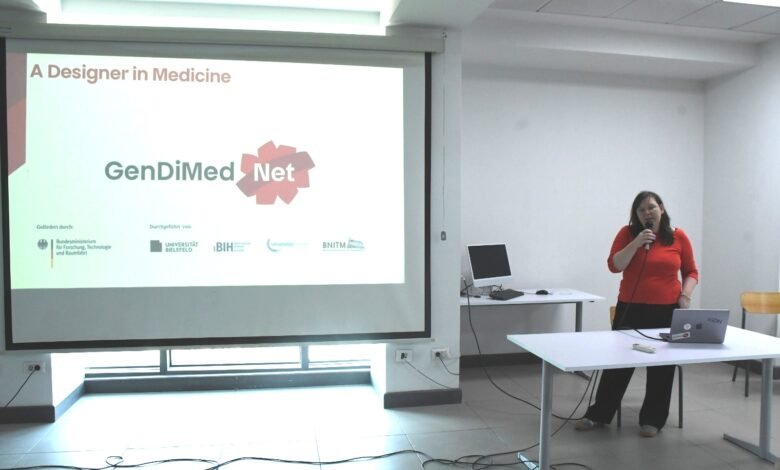


As part of the German University in Cairo’s (GUC) commitment to broadening the intellectual horizons of its students and faculty members, while strengthening the connection between education and contemporary research and practical challenges, the Faculty of Applied Sciences and Arts organized a specialized academic lecture entitled “Who Is Healthcare Designed For?” The lecture was delivered by German researcher Claudia Herling. Her work focuses on the intersection of design, digital product development, and gender.
The lecture explored the pivotal role of design in shaping healthcare systems, emphasizing that design extends far beyond the aesthetic appearance of objects to influence the quality and efficiency of healthcare services. It highlighted that hospitals, digital applications, medical devices, implants, and even pharmaceutical leaflets are all outcomes of design processes that incorporate underlying assumptions about human nature, individual needs, physical capabilities, and lifestyles.
Between Standardized Criteria and Human Diversity: How Is Gender-Sensitive Design Reshaping the Future of Healthcare?
The lecture featured an in-depth intellectual discussion on the extent to which innovative designs are inclusive and responsive to individual human differences. It highlighted a critical gap within the healthcare sector, raising a fundamental question: Are existing healthcare solutions designed to meet the needs of every individual in all their unique diversity, or are they based on a single, rigid standard that fails to reflect the complexity of human differences?
In this context, fruitful discussions focused on the concept of Gender-Sensitive Design and its crucial role in developing advanced medical technologies and applications that intelligently and flexibly respond to different biological and psychological needs. Such an approach helps ensure equitable healthcare that takes into account differences among users in terms of age, physical and sensory abilities, and specific healthcare requirements, ultimately contributing to the development of a more inclusive and equitable healthcare system.
The lecture which was initiated by Prof. Dr. Brigitte Wolf also provided students with valuable insights into how design, scientific research, and technology can be integrated to address real-world challenges that directly affect human lives and health. Researcher Claudia Herling enriched also the “Advanced Research Methods” course—which this semester focuses on the topic “Public Health: Considering Gender Differences”—with her knowledge and research findings.
Commenting on the event, Prof. Sabine Müller, Dean of the Faculty of Applied Sciences and Arts at GUC, emphasized that organizing this lecture reflects the growing importance of integrating human and social dimensions into technological innovation.
She explained that this approach opens new horizons for students and researchers to develop critical and creative thinking, while reinforcing their awareness that design quality should not be measured solely by functional and technical efficiency, but, above all, by its ability to address human needs across diverse circumstances and individual characteristics.
Prof. Dr. Brigitte Wolf added that the Faculty is committed to organizing such academic events out of its belief in the importance of engaging with international research expertise and providing interactive platforms through which students and faculty members can connect with inspiring global perspectives and experiences. These exchanges contribute to advancing design thinking and directly linking it to contemporary societal and humanitarian challenges.
It is worth noting that Claudia Herling holds a Diploma in Design the Köln International School of Design (KISD) and serves as Chair of the International Gender Design Network (iGDN). Her professional career bridges hands-on expertise in digital systems and user experience (UX) with academic research dedicated to integrating equality and gender-sensitive criteria into artificial intelligence and technology development. Since October 2025, she has been pursuing her research at Bielefeld University in Germany as part of the GenDiMedNet project, which focuses on leveraging digital technologies to advance gender-sensitive medicine—building on her extensive research background at Heilbronn University of Applied Sciences.