AUC COMPUTER ENGINEERING STUDENTS EARN GLOBAL RECOGNITIONFOR AI RESEARCH

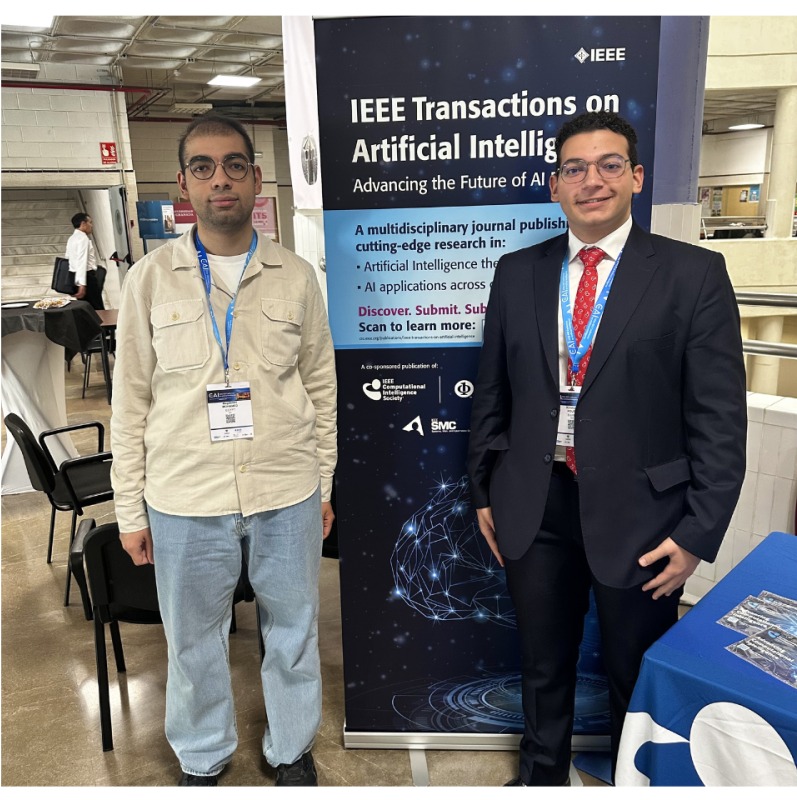
Cairo, July 7, 2026 – A team of computer engineering students at The American University in Cairo (AUC) presented innovative research on a new artificial intelligence model at the 2026 IEEE Conference on Artificial Intelligence in Granada, Spain. The research, conducted as an undergraduate thesis project under the guidance of Cherif Salama, professor, AUC Department of Computer Science and Engineering, is designed to produce an energy-efficient AI model, challenging a dominant assumption in the AI industry that bigger models produce better results. The research team included Kirolous Fouty, MagdElDin Mohamed, Andrew Aziz, Mohamed Abbas, Shaza Ali and Tarek Kassab. Fouty and Mohamed represented AUC at the conference, where they were the youngest participants among industry professionals and established academics from around the world.
The new model addresses two main challenges faced by large AI models: high energy consumption and a tendency to produce
false or inaccurate information. To overcome these limitations, the AUC team designed an alternative approach, buildin amodelthat first extracts data from graphs and charts, then feeds that information into a reasoning engine to deliver highly precise results.
“We didn’t want to just do a standard school project; we wanted to build something that could compete on a global stage,” Fouty said. He added that the project helped drive home an important message about the future of AI: that progress depends not on building massive, energy-draining models, but on smarter architecture. Fouty explained that by developing a model 10 times smaller than comparable systems, the team demonstrated that cutting-edge AI can be accessible, sustainable and resource-efficient.
Fouty noted that participants at the conference were shocked to learn that the research had been conducted as part of a bachelor’s
thesis. “They were really proud of the work we were able to accomplish at such an early stage.”
The students’ research presentation was followed by a discussion session with professional researchers, sparking discussion on everything from their datasets and chart languages to their fine-tuning processes and inference times.
“What impressed me most about this team is that they challenged the assumption that better AI must always mean larger AI,” said Salama. “Through a disciplined, table-first reasoning pipeline, they built a highly efficient model that outperformed much larger state-of-the-art systems in chart question answering. That achievement is both technically meaningful and educationally inspiring because it shows that undergraduate research can contribute original ideas to one of the most active areas of AI.”
Following the conference, the team’s paper is set to be published in the IEEE Xplore digital library, a significant academic
milestone for graduating seniors and a mark of international recognition for their research.
The project reflects AUC’s continued commitment to research excellence that places its students in direct dialogue with leading global institutions. By taking on one of the most pressing challenges in contemporary AI development, the tradeoff between scale and sustainability, the AUC team has shown that undergraduate researchers, guided by rigorous mentorship, are capable of producing work that competes at the highest international levels.