PRESIDENT OF FINLAND ADDRESSES SHIFTING GLOBAL POWER DYNAMICS AT AUC

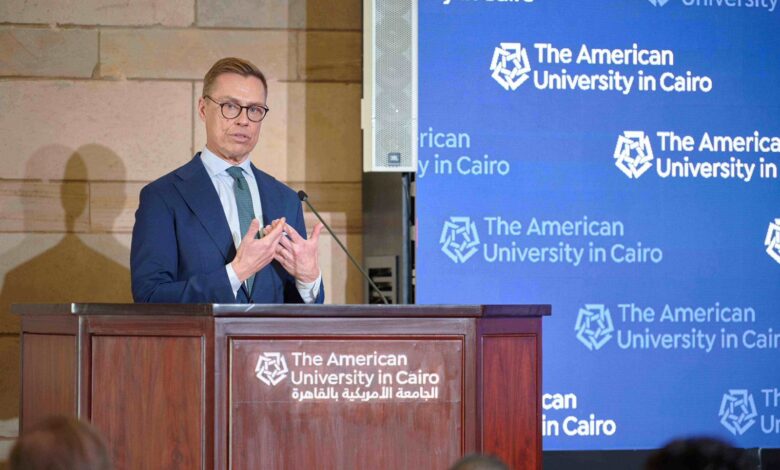
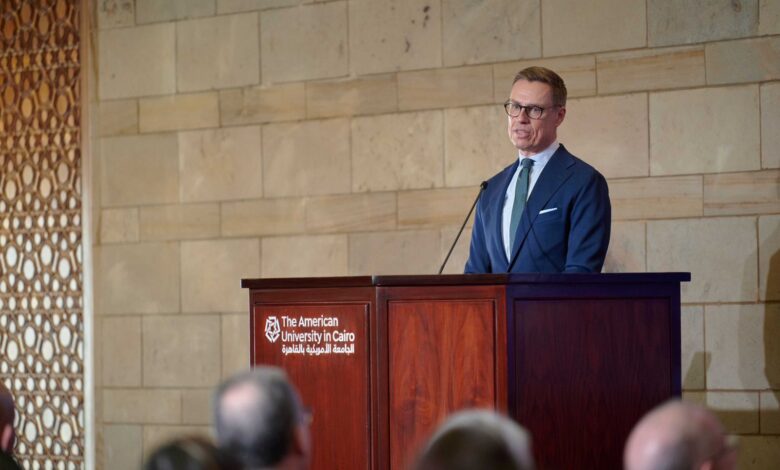
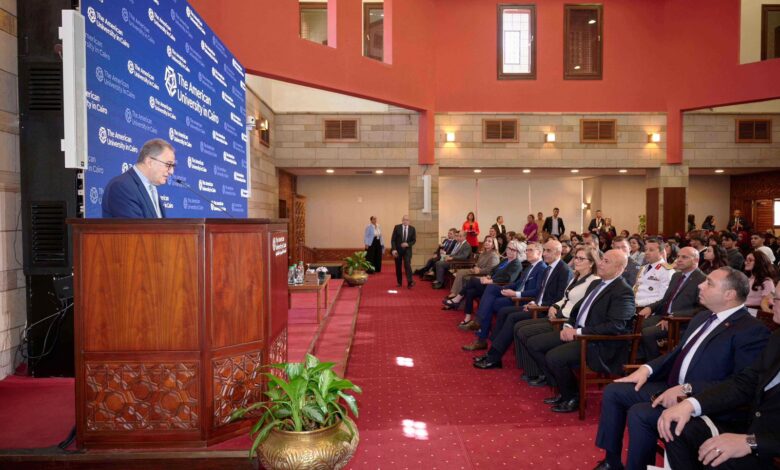
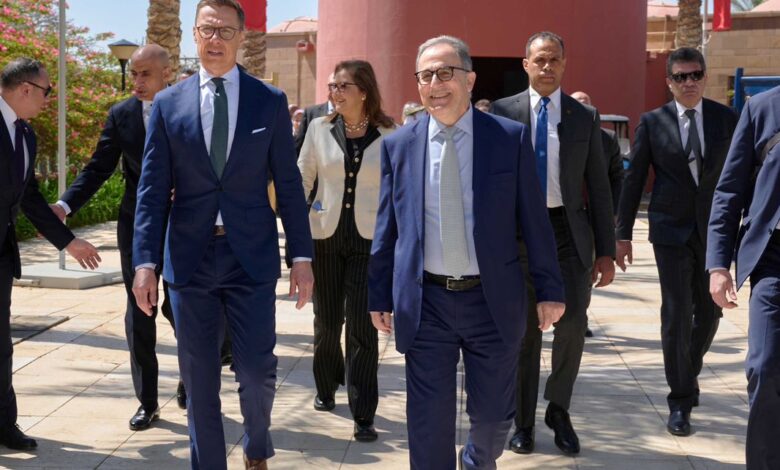
The American University in Cairo (AUC) welcomed President of the Republic of Finland, Alexander Stubb, for a high-profile visit to its New Cairo campus to deliver a talk titled “Global Transitions and Changing Balance of Power,” followed by an interactive conversation with students from AUC, Cairo University and Badr University. The visit marked a cornerstone of the President’s official diplomatic mission to Egypt and his commitment to engaging with the next generation of global leaders.
The event brought together a distinguished audience that included the Minister of Education and Technical Education, Mohamed Abdel Latif; Ambassador of Egypt to the Republic of Finland, Mohamed Ghoneim; Ambassador of the Republic of Finland to Egypt, Riikka Eela; President of Cairo University, Mohamed Sami Abdelsadek; President of Badr University, Ashraf El-Shihy; AUC trustees and AUC senior leadership.
Welcoming President Stubb to campus, AUC President Ahmad Dallal said, “Mr. President, it is a distinct honor to host you on our campus. We are especially grateful that you have chosen to include an extended engagement with university students as part of your visit to Egypt. Encounters of this kind are an important part of the educational experience we aim to offer at AUC. They expose students to ideas shaped by disciplined scholarship, public responsibility and sustained engagement with complex global questions.”
Dallal highlighted President Stubb’s longstanding commitment to engaging academic communities during his international visits, noting that his conversations have consistently addressed the major shifts shaping the global landscape. Dallal added that the talk, titled “Global Transitions and Changing Balance of Power,” continues this important dialogue and carries particular resonance in Cairo, where students study international systems from within a region in which global transitions are both deeply felt and actively debated. The discussion, he noted, offers a valuable opportunity to examine these issues through a perspective grounded in sustained research and public service.
In his talk to students and guests from AUC and other universities, President of Finland Alexander Stubb tackled the shifting global balance of power, describing it as a historic “realignment” of the international order. He reflected on the profound transformations shaping global politics, noting that the world is entering a new era marked by changes in power structures, institutions, and alliances. “We are witnessing a realignment on three accounts,” he said. “A global realignment of power, a regional realignment of power, and actually a local realignment of power.”
Stubb noted that the current transition, which he said began with Russia’s war in Ukraine and has accelerated amid shifts in US foreign policy, marks a significant turning point in world affairs. He contrasted a rules-based multilateral system with an increasingly transactional and conflict-prone multipolar world, emphasizing his support for international institutions, norms, and cooperation. “I believe more in rules, regulations, and norms than in this dog-eat-dog world that we are seeing today,” he said.
In his remarks, Alexander Stubb outlined a shifting global landscape shaped by what he described as a “triangle of power,” comprising three main blocs: the Global West, led by the United States and encompassing around 50 countries seeking to preserve the current international order; the Global East, driven by China and Russia and consisting of approximately 25 countries aiming to reshape that order; and the Global South, a diverse group of about 125 nations, including key middle powers such as Egypt, India, and Brazil. He underscored that the Global South is no longer a passive player, highlighting Egypt’s young population—around 60 percent under 30—as a sign of significant demographic and economic potential, and calling on middle powers to assert greater influence in shaping the future balance of global power. “Now is the moment when middle powers take the agency and power that I think belongs to them,” he urged.
He also called for urgent reform of international institutions, particularly the United Nations, arguing that existing structures no longer reflect contemporary geopolitical realities. His specific proposals included doubling the UN Security Council membership to ten, granting permanent seats to Africa, Asia, and Latin America, and scrapping the veto power to ensure the institution reflects 21st-century realities rather than post-1945 victors.
Throughout the discussion, Stubb underscored the importance of education, open-mindedness, and lifelong learning, drawing on his own academic journey and urging students to remain intellectually curious in a rapidly changing world.
The event concluded with an interactive Q&A session, during which students from AUC, Cairo University, and Badr University raised questions on the role of the Global South, the ability of middle powers to reform global institutions, Finland’s accession to NATO, Egypt-Finland cooperation, the conflict at the Strait of Hormuz, education, and rising intolerance in Europe. In response, Stubb highlighted the increasing agency of middle powers, the importance of strategic partnerships, and the need for moderation, tolerance, and dialogue in addressing contemporary global challenges.
President Stubb’s visit underscores AUC’s ongoing commitment to serving as a leading platform for dialogue on the most critical global issues and for connecting students with world leaders, policymakers and influential thinkers.
Founded in 1919, The American University in Cairo (AUC) is a leading English-language, American-accredited institution of higher education and center of the intellectual, social, and cultural life of the Arab world. It is a vital bridge between East and West, linking Egypt and the region to the world through scholarly research, partnerships with academic and research institutions and study abroad programs.
The University offers 39 undergraduate, 52 master’s and two PhD programs rooted in a liberal arts education that encourages students to think critically and find creative solutions to conflicts and challenges facing both the region and the world.
An independent, nonprofit, politically non-partisan, non-sectarian and equal opportunity institution, AUC is fully accredited in Egypt and the United States.